Market Sentiment
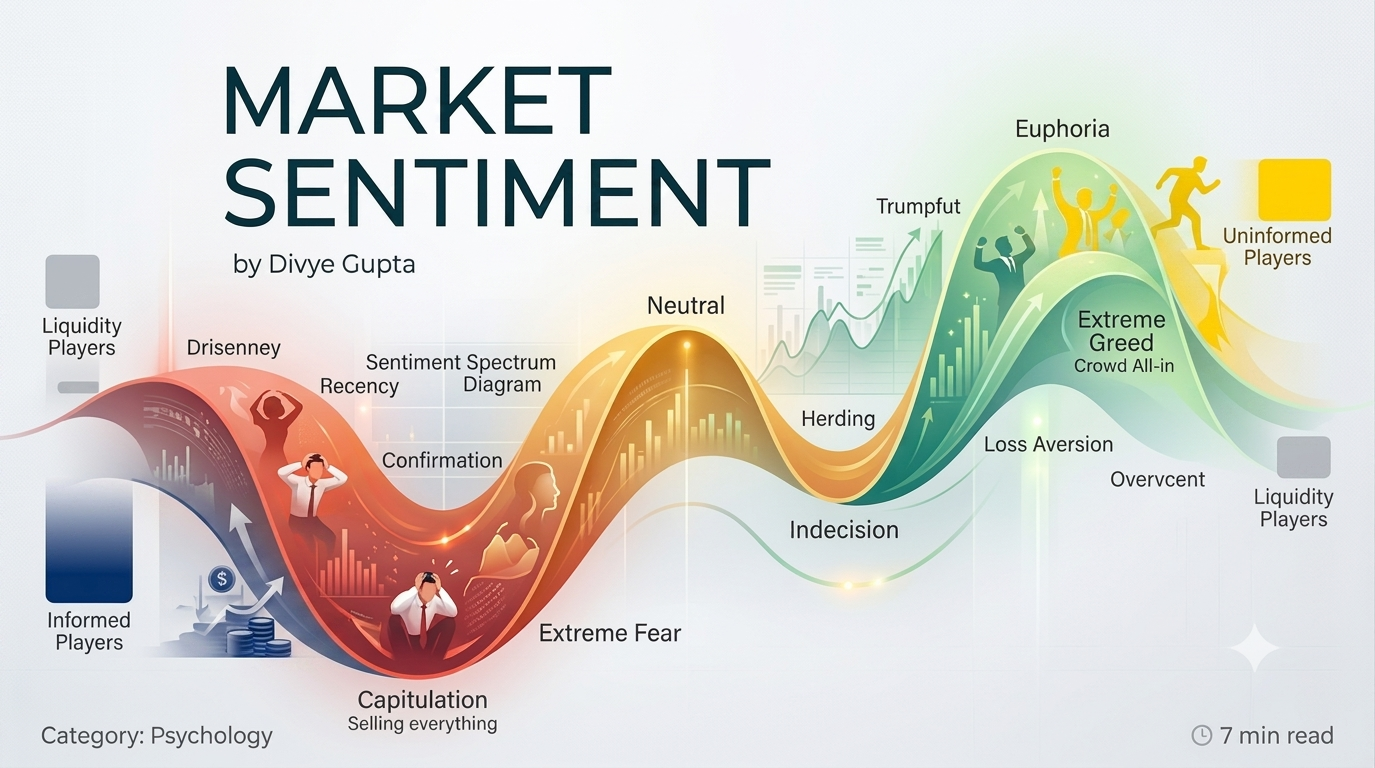
What is sentiment?
Sentiment is the net emotional temperature of a market at any given moment — the aggregate weight of optimism or pessimism held by every participant whose buy or sell order is moving price. It is not a rumour, a forecast, or an opinion piece. It is the living, collective expectation of what an asset will do next, reflected directly in price and volume.
Think of it as a vote. Every trade cast is a vote of confidence or a vote of fear. Sentiment is the running tally.
"Price is what you pay. Value is what you get." — Warren Buffett
Sentiment is the gap between the two.
The theory of contrarian investing
The contrarian principle is simple to state and painfully hard to act on:
Whenever non-professional investors become significantly one-sided in their expectations about the future course of prices, the market will move in the opposite direction to what the masses anticipate.
Why? Because by the time a view becomes consensus, it is already priced in. There is nobody left to buy when everyone is bullish, and nobody left to sell when everyone is bearish. The fuel has been spent. The only direction remaining is the one the crowd did not expect.
This is not mysticism — it is market mechanics. When retail sentiment reaches extremes, informed capital steps in on the other side and the reversion begins.
The three types of market players
Not all participants are equal in their influence or their rationality. Understanding who is on the other side of your trade is just as important as the trade itself.
Liquidity players hold a peripheral relationship with the market. They transact for reasons unrelated to price forecasting — think institutional rebalancing, index funds on autopilot, or retail savers making scheduled contributions. Their trades add volume but carry no directional conviction. Their sentiment tells you nothing.
Uninformed players — often called noise traders — are ruled by what they feel rather than what they know. They buy into rallies because the headlines are good and panic-sell into corrections because the headlines are terrifying. Their trades are the thermometer of crowd emotion, and their one-sidedness is precisely the signal a contrarian needs.
Informed players are the counterweight. They have done the research, understand valuation, and have the psychological steel to act against the crowd. They are the ones selling into strength when the uninformed are piling in, and the ones accumulating quietly while the uninformed are liquidating in panic.
The strategy distils to three rules:
- Follow the informed traders
- Fade the uninformed traders
- Disregard the liquidity traders
Human biases quietly wreck decisions
The efficient market hypothesis holds that rational participants will always correct any mis-pricing created by irrational ones. The uncomfortable truth is that rationality is the exception, not the norm — and even investors who intellectually accept this tend to exempt themselves from it.
Everyone knows they should buy low and sell high. Most people do the opposite — selling into weakness after the pain becomes unbearable and buying into strength when confidence has already peaked.
The gap between knowing and doing is where cognitive bias lives. A few that matter most for traders:
- Recency bias — recent events feel more representative of the future than they are. A five-day losing streak feels like a permanent trend.
- Confirmation bias — once a view is formed, contradictory evidence is filtered out. Bullish traders see bullish news; bearish traders see bearish news.
- Loss aversion — losses feel roughly twice as painful as equivalent gains feel pleasurable, which causes traders to hold losers too long and cut winners too early.
- Herding — the discomfort of being wrong alone is greater than the comfort of being right alone. This drives clustering into crowded trades exactly when those trades become dangerous.
- Overconfidence — most traders rate their own ability as above average. Statistically, this is impossible.
The honest conclusion: the market does not move against you because of bad luck. It often moves against you because of predictable, well-documented human tendencies that you share with every other participant — including the professionals who manage billion-dollar funds.
What this means for your trading
Sentiment analysis is not about predicting the future. It is about identifying when the crowd is so lopsided that the risk/reward of following them has become unfavourable — and positioning yourself accordingly.
A few practical anchors:
- Track put/call ratios, the AAII sentiment survey, and the CNN Fear & Greed Index as crowd-temperature gauges, not as precise timing tools.
- Be suspicious of your own conviction when it aligns perfectly with the headlines.
- The trades that feel the most uncomfortable are often the ones with the best expected value.
- Keep a trading journal. Writing down the reasoning behind every trade surfaces the biases you cannot see in the moment.
Put this pattern to work in your own journal.
Start free trial →